Black garlic has transformed from an obscure Asian delicacy into a global culinary sensation, cherished for its unique sweet, savory, and umami notes, and its impressive health benefits. To achieve this fermented marvel at home, a dedicated black garlic fermenter is an invaluable tool. As you navigate the market, you’ll notice various models, often differentiated by their power ratings, with 70-watt and 90-watt units being common choices for home users. But what does this wattage difference truly mean for your fermentation process, energy bill, and the quality of your black garlic? This article delves into a detailed comparison to help you make an informed decision.
Understanding Black Garlic Fermentation and Power Needs
The magic of black garlic production lies in a carefully controlled Maillard reaction, a complex process of amino acids and reducing sugars reacting at sustained low temperatures and specific humidity levels over several weeks. Unlike traditional fermentation, this process doesn’t typically involve microbial action but relies on heat to transform fresh garlic cloves into their dark, sweet, and sticky counterparts.
A black garlic fermenter’s primary role is to maintain a consistent temperature range, typically between 60°C and 90°C (140°F-194°F), for an extended period—usually 7 to 12 days, or even longer for some varieties. The wattage of the appliance indicates how much electrical power it consumes to generate and maintain this heat. In essence, higher wattage generally means a greater capacity to produce heat.
The 70-Watt Black Garlic Fermenter: Efficiency and Applications
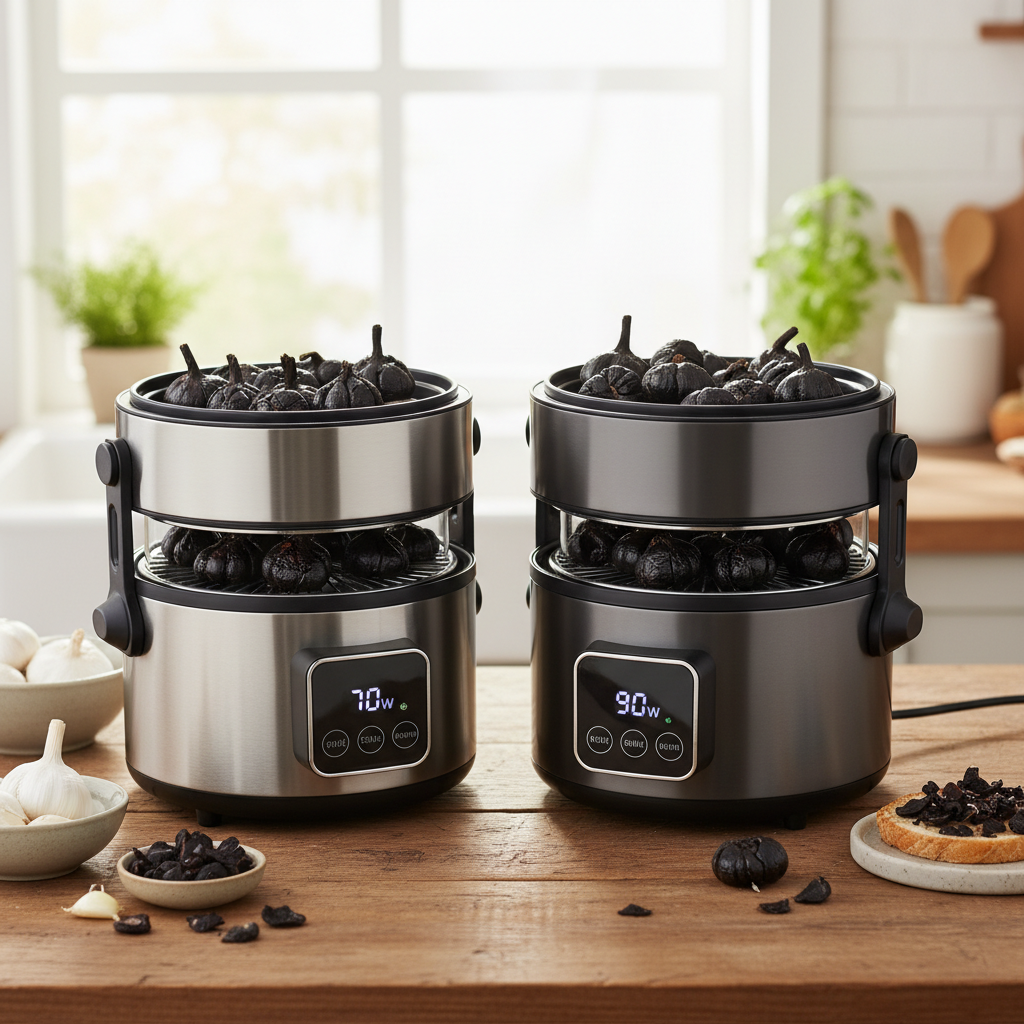
A 70-watt black garlic fermenter is often positioned as an energy-efficient option, consuming less power at any given moment compared to its 90-watt counterpart. These units are typically designed for home use, catering to individuals or small families who make black garlic in moderate quantities.
The primary advantage of a 70-watt model is its lower theoretical power draw, which can translate to a marginally lower electricity cost over the lengthy fermentation cycle. For a well-insulated unit, 70 watts can be perfectly sufficient to reach and maintain the required temperatures, especially in environments with stable ambient temperatures. These models are ideal for smaller batches or for users prioritizing minimal energy consumption.
However, a 70-watt fermenter might exhibit slightly slower heating times when starting up or recovering from temperature drops (e.g., after a brief power interruption or opening the lid). In colder environments, it may also need to work harder, running its heating elements more frequently or for longer durations, to maintain the precise temperature, potentially offsetting some of the initial energy-saving advantages.
The 90-Watt Black Garlic Fermenter: Performance and Considerations
Stepping up to a 90-watt black garlic fermenter introduces a modest increase in power, which can offer several performance benefits without dramatically impacting energy costs. Many manufacturers market their 90-watt units as “energy-saving,” highlighting that this power level is efficient enough to complete the fermentation process without consuming excessive electricity.
The added 20 watts can translate to quicker heating, allowing the unit to reach the optimal fermentation temperature faster. More importantly, a 90-watt fermenter may offer more robust temperature stability. This can be particularly beneficial in environments with fluctuating ambient temperatures or if you are fermenting larger batches of garlic within the unit’s capacity. The extra power helps the fermenter maintain a consistent internal temperature, which is crucial for achieving uniform black garlic quality. Some 90W models feature advanced heating designs, like double-layer inner pots, to ensure even heat distribution.
While it theoretically consumes slightly more electricity than a 70-watt model, the difference in a typical home setting over a 7-12 day cycle is often negligible. The enhanced performance, especially in maintaining stable temperatures, can lead to more reliable and consistent results.
Direct Comparison: 70W vs. 90W – What the Numbers Mean for You
When comparing 70W and 90W black garlic fermenters, it’s essential to consider the practical implications rather than just the raw wattage. The difference of 20 watts is quite small in the grand scheme of household energy consumption.
Here’s a breakdown of the key comparative aspects:
| Feature | 70W Fermenter | 90W Fermenter |
|---|---|---|
| Power Consumption | Lower theoretical power draw | Marginally higher theoretical power draw |
| Heating Speed | Moderate, may take longer to stabilize | Potentially faster to reach and recover temp |
| Temperature Stability | Good in ideal conditions | Potentially more robust, especially with fluctuations |
| Ideal Use Case | Smaller batches, highly energy-conscious users | Standard home use, slightly larger batches, varying ambient temps |
| Energy Cost Impact | Very low | Still very low, with a minimal increase |
To put the energy cost into perspective, consider a 10-day (240-hour) fermentation cycle:
- 70W unit: 0.07 kW * 240 hours = 16.8 kWh
- 90W unit: 0.09 kW * 240 hours = 21.6 kWh
If your electricity costs $0.15 per kWh, the difference over 10 days would be:
(21.6 kWh – 16.8 kWh) $0.15/kWh = 4.8 kWh $0.15/kWh = $0.72.
This demonstrates that the monetary difference in energy consumption between a 70W and 90W unit over a full fermentation cycle is minimal for a home user, often less than a dollar. Therefore, the decision should lean more towards performance, capacity, and other features rather than solely on the small wattage differential.
Beyond Wattage: Key Factors Influencing Black Garlic Fermenter Choice
While wattage provides an indication of heating capability, it’s not the sole determinant of a fermenter’s efficiency or the quality of its output. Several other factors play a crucial role:
Capacity
|
Our Picks for the Best Black garlic fermenter in 2026
As an Amazon Associate I earn from qualifying purchases.
|
||
| Num | Product | Action |
|---|---|---|
| 1 | WantJoin Black Garlic Fermenter 6L - Full Automatic Intelligent Control Black Garlic Maker, 360° Even Fermented,Makes 3-4 LBS Garlic Fermenter Machine, Makes Multi Clove & Whole Clove Garlic |

|
| 2 | INTBUYING 6L Black Garlic Fermenter,Garlic Ferment,Black Garlics Ferment Pot,Full Automatic Intelligent Control Black Garlics Maker Black Garlic Maker |
|
| 3 | 6L Black Garlic Fermenter,Yogurt Maker with Adjustable Temperature & Time Control,Kimchi machine,Sweet Rice Wine Maker Full Automatic,Natto Maker,FCC UL Listed |
|
| 4 | 5L Black Garlic Fermenter Full Automatic Intelligent Control Garlics Maker Multi Clove Garlic Cooker FCC UL Approved |
|
| 5 | 110V 6L Black Garlic Fermenter Intelligent Fully Automatic Black Garlic Machine Black Garlics Ferment Pot Garlic Ferment Box Black Garlic Maker DIY Cooker |
|
| 6 | Moongiantgo 8L Black Garlic Fermenter Garlic Fermenting Machine, Easy One-Button Operation Automatic Intelligent Large Capacity Black Garlic Maker with Precise Time Control for 6-16 Days, 110V (8L) |
|
| 7 | Moongiantgo 7.5L Black Garlic Fermenter, Automatic Intelligent Control Garlic Fermenter Natto, Yogurt, Kimchi, Wine Fermenter Machine, Garlic Cooker with Precise Time Temperature Control, 110V (Brown) |
|
| 8 | 6L Black Garlic Fermenter Multifunctional Intelligent Fermenter Pot 6L Black Garlic, Sweet Rice, Natto,Yogurt Maker Garlic Fermenter Machine DIY Cooker |
|
| 9 | 5L Black Garlic Fermenter, Automatic Garlic Fermenting machine, Wine Fermenting Machine, Yogurt Maker with Temperature Control |
|
| 10 | TECHTONGDA 5L Black Garlic Fermenter 110V Garlic Cooker 3D Heating Full Automatic Intelligent Control |
|
Consider how much black garlic you want to make at once. A 6L capacity unit, common with 90W models, can ferment approximately 3.3 to 4.4 lbs of garlic. Match the fermenter’s capacity to your needs to avoid multiple cycles for small amounts or being unable to process a desired batch size.
Insulation and Construction Quality
A well-insulated fermenter will retain heat more effectively, regardless of its wattage. This means it requires less energy to maintain the target temperature, leading to greater efficiency. Look for units made with durable, heat-retaining materials.
Temperature Control Precision
The fermenter’s ability to maintain a stable and accurate temperature throughout the fermentation period is paramount. Look for models with intelligent temperature control systems that prevent significant fluctuations, which can negatively impact the black garlic’s texture and flavor.
Even Heating Mechanisms
Consistent heating across all garlic cloves is vital for uniform results. Features like a double-layer inner pot or a cage-like design promote better air circulation and even heat distribution, ensuring every clove ferments perfectly.
User Reviews and Brand Reputation
Experience from other users can offer valuable insights into a fermenter’s real-world performance, reliability, and actual energy efficiency. Brands with a good reputation often provide better customer support and product longevity.
Maximizing Energy Efficiency Regardless of Wattage
No matter if you choose a 70W or 90W fermenter, you can adopt practices to maximize its energy efficiency:
- Optimal Placement: Place your fermenter in a location with a stable room temperature, away from drafts or direct sunlight. This helps the unit maintain its internal temperature more easily.
- Avoid Frequent Opening: Resist the urge to frequently open the lid, as this releases heat and moisture, forcing the machine to expend more energy to recover.
- Proper Loading: Load the garlic according to the manufacturer’s recommendations. Overfilling can lead to uneven fermentation, while underfilling might be less energy-efficient per batch.
- Ensure Proper Ventilation: Some fermenters require ventilation to release excess gas. Ensure any venting holes are clear.
Conclusion
The choice between a 70-watt and a 90-watt black garlic fermenter for home use often boils down to subtle performance differences rather than a significant impact on your electricity bill. Both fall into the “low power” category for extended use appliances, with the monetary cost difference over a typical fermentation cycle being minimal. A 90-watt unit may offer a slight edge in heating speed and temperature stability, particularly beneficial in less consistent environments or for slightly larger batches. However, a well-designed 70-watt unit can be equally effective.
Ultimately, prioritize features like capacity, insulation, precise temperature control, and proven even-heating mechanisms over a minor wattage difference. Reading user reviews and choosing a reputable brand will also contribute to a satisfying black garlic fermentation experience. By considering these factors, you can select a machine that consistently delivers delicious, perfectly fermented black garlic, cycle after cycle.
Frequently Asked Questions
Does higher wattage mean better black garlic?
Not necessarily. While higher wattage (like 90W) can contribute to faster heating and more stable temperature control, which are important for consistent black garlic, the overall design, insulation, and precision of the temperature control system are more critical for the quality of the black garlic.
How much electricity does a black garlic fermenter use per cycle?
A typical black garlic fermenter running for 10 days (240 hours) would consume approximately 16.8 kWh for a 70W unit and 21.6 kWh for a 90W unit. The exact cost depends on your local electricity rates, but the total for one cycle is usually very low, often under a few dollars.
Can I use a slow cooker instead of a dedicated fermenter?
While some enthusiasts attempt black garlic fermentation in slow cookers or rice cookers using a “keep warm” setting, dedicated black garlic fermenters are specifically designed to maintain the precise temperature and humidity required for optimal results over an extended period, which slow cookers may struggle to do consistently. This can lead to more reliable and higher-quality black garlic.