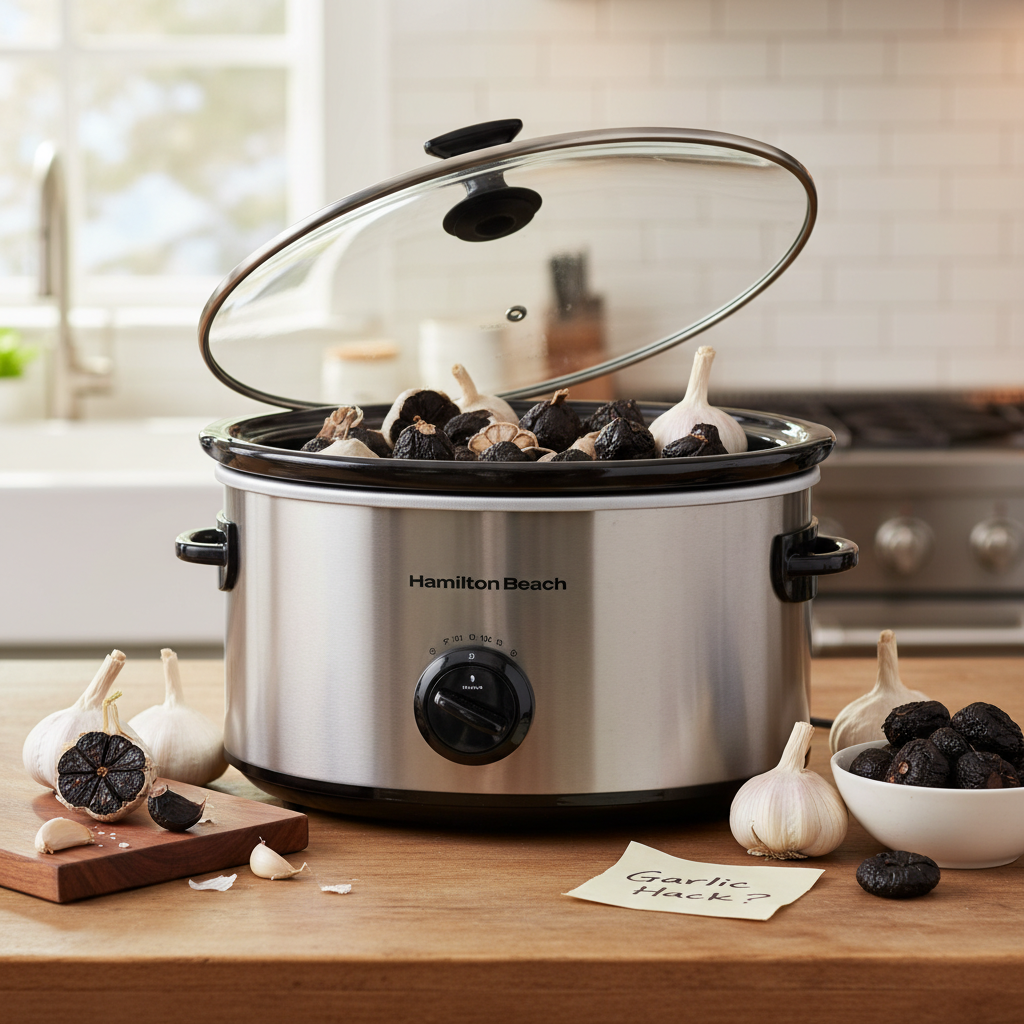
Imagine a world where every clove of black garlic is perfectly fermented, achieving optimal flavor, texture, and nutritional value, regardless of its origin or the specific conditions. While today’s “smart” black garlic fermenters offer automated convenience, the true revolution lies in integrating advanced Artificial Intelligence (AI). This is not merely about setting a timer; it’s about intelligent systems that learn, adapt, and predict, transforming black garlic production into a precise science and paving the way for a new era in food technology.
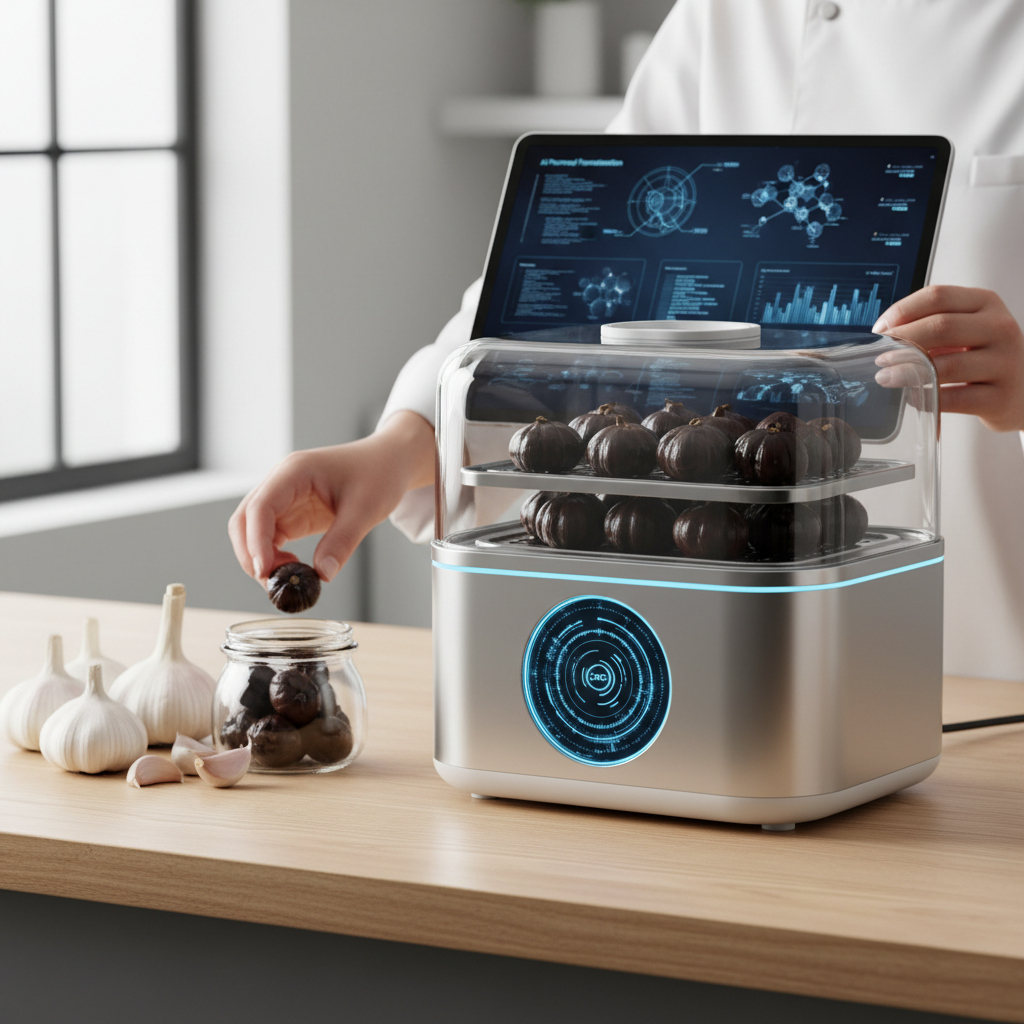
Overview of Black Garlic Fermenters
Black garlic, a culinary delicacy with a history spanning centuries, is renowned for its unique sweet and savory taste, soft texture, and enhanced health benefits. Unlike fresh garlic, black garlic undergoes a transformative process known as the Maillard reaction, a complex series of chemical changes driven by carefully controlled heat and humidity over several weeks. This aging process converts the sharp, pungent compounds into milder, more complex flavors, while also increasing antioxidant levels.
Traditionally, black garlic production was a labor-intensive endeavor, often yielding inconsistent results. The advent of modern black garlic fermenters has democratized this process, bringing it from industrial settings to home kitchens. These machines automate the crucial environmental controls, maintaining stable temperatures and humidity levels necessary for the Maillard reaction to occur. They offer a significant leap over rudimentary methods, providing convenience and a higher degree of reliability. However, while “smart” in their automation, current models represent only the foundational steps towards truly intelligent, AI-powered systems.
Current “Intelligent” Fermenters vs. The Vision of AI-Powered Fermenters
The distinction between today’s “intelligent” black garlic fermenters and the conceptual AI-powered models of tomorrow lies in their fundamental approach to control and optimization. Understanding this difference illuminates the profound potential AI holds for the future of fermented foods.
Current “Smart” Fermenters
Today’s commercially available black garlic fermenters are indeed “smart” in their automation. They feature integrated heating elements, humidity sensors, and programmable logic controllers that maintain a preset environment. Users select a desired fermentation cycle, typically ranging from 7 to 15 days, and the machine handles the rest. Many models offer multi-purpose functions, allowing for the creation of other fermented products like yogurt or natto. Key features often include:
- Automated Temperature and Humidity Control: Maintaining a consistent range (e.g., 60-80°C and 80-90% relative humidity) is crucial for the Maillard reaction.
- Pre-set Programs: Offering different durations or intensity settings for various garlic types.
- Power-off Memory: Resuming the cycle after a power interruption, preventing spoilage.
- User-Friendly Design: Digital displays and one-touch operation.
- Capacity Options: Ranging from small countertop units for home use to larger commercial models.
|
Our Picks for the Best Black garlic fermenter in 2026
As an Amazon Associate I earn from qualifying purchases.
|
||
| Num | Product | Action |
|---|---|---|
| 1 | TECHTONGDA 5L Black Garlic Fermenter 110V Garlic Cooker 3D Heating Full Automatic Intelligent Control |

|
| 2 | Moongiantgo 8L Black Garlic Fermenter Garlic Fermenting Machine, Easy One-Button Operation Automatic Intelligent Large Capacity Black Garlic Maker with Precise Time Control for 6-16 Days, 110V (8L) |
|
| 3 | 6L Black Garlic Fermenter Multifunctional Intelligent Fermenter Pot 6L Black Garlic, Sweet Rice, Natto,Yogurt Maker Garlic Fermenter Machine DIY Cooker |
|
| 4 | 5L Black Garlic Fermenter, Automatic Garlic Fermenting machine, Wine Fermenting Machine, Yogurt Maker with Temperature Control |
|
| 5 | WantJoin Black Garlic Fermenter 6L - Full Automatic Intelligent Control Black Garlic Maker, 360° Even Fermented,Makes 3-4 LBS Garlic Fermenter Machine, Makes Multi Clove & Whole Clove Garlic |
|
| 6 | 6L Black Garlic Fermenter,Yogurt Maker with Adjustable Temperature & Time Control,Kimchi machine,Sweet Rice Wine Maker Full Automatic,Natto Maker,FCC UL Listed |
|
| 7 | INTBUYING 6L Black Garlic Fermenter,Garlic Ferment,Black Garlics Ferment Pot,Full Automatic Intelligent Control Black Garlics Maker Black Garlic Maker |
|
| 8 | 110V 6L Black Garlic Fermenter Intelligent Fully Automatic Black Garlic Machine Black Garlics Ferment Pot Garlic Ferment Box Black Garlic Maker DIY Cooker |
|
| 9 | Moongiantgo 7.5L Black Garlic Fermenter, Automatic Intelligent Control Garlic Fermenter Natto, Yogurt, Kimchi, Wine Fermenter Machine, Garlic Cooker with Precise Time Temperature Control, 110V (Brown) |
|
| 10 | 5L Black Garlic Fermenter Full Automatic Intelligent Control Garlics Maker Multi Clove Garlic Cooker FCC UL Approved |
|
These features have made black garlic production accessible and reliable, removing much of the guesswork associated with traditional methods.
The Leap to AI: What “AI-Powered” Truly Means
While current fermenters are automated, they lack the adaptive learning and predictive capabilities that define true AI. An “AI-powered” garlic fermenter transcends simple programming; it integrates advanced machine learning algorithms, robust sensor networks, and data analytics to achieve dynamic, real-time optimization. It’s about moving from a static, rule-based system to one that continuously learns and improves.
True AI in this context would involve:
- Predictive Analytics: Analyzing historical data and current conditions to forecast optimal fermentation trajectories.
- Real-time Dynamic Optimization: Adjusting parameters like temperature, humidity, and air circulation on the fly based on subtle changes detected in the garlic itself (e.g., moisture content, aroma compounds).
- Machine Learning Algorithms: Learning from vast datasets of successful and unsuccessful fermentations, encompassing different garlic varieties, batches, and desired outcomes, to refine its process models.
- Digital Twins: Creating virtual replicas of the fermentation environment to simulate and test conditions without disturbing actual production.
- Advanced Sensor Integration: Utilizing biosensors and computer vision to monitor the garlic’s physical and chemical changes throughout the process, providing granular data.
This leap means an AI-powered fermenter wouldn’t just follow instructions; it would understand, adapt, and innovate, pushing the boundaries of what’s possible in black garlic creation.
How AI Will Revolutionize Black Garlic Production
The integration of AI into black garlic fermentation promises to transform the process from an art form reliant on human intuition into a precision science. This will lead to unprecedented levels of consistency, quality, and innovation.
Precision Fermentation and Optimal Conditions
AI will enable black garlic fermenters to move beyond static, pre-set programs. Imagine a system that learns from millions of data points across diverse garlic varieties, climates, and desired outcomes. AI-powered fermenters could dynamically adjust temperature, humidity, and even air flow in real-time, minute by minute, based on the specific characteristics of the garlic being processed. This precision would ensure ideal conditions are maintained throughout the Maillard reaction, optimizing the development of its signature sweet, umami flavor, soft texture, and potent bioactive compounds. For instance, different garlic cultivars might have varying sugar and amino acid profiles, requiring bespoke fermentation curves that only an AI could intelligently discern and implement.
Enhanced Quality Control and Consistency
One of the biggest challenges in any food processing, including black garlic, is achieving consistent quality across batches. AI can fundamentally change this. Advanced sensors, coupled with computer vision and machine learning, could continuously monitor the garlic’s appearance, texture, and even subtle changes in aroma. The AI would detect deviations from ideal profiles immediately, making micro-adjustments to prevent issues like over-drying, carbonization, or uneven fermentation. This real-time feedback loop would ensure every batch meets precise quality standards, drastically reducing waste and guaranteeing a superior, uniform product.
Accelerated Research and Development
Developing new food products and optimizing existing ones is often a lengthy and resource-intensive process of trial and error. AI can act as a powerful accelerator for R&D in black garlic. By simulating countless fermentation scenarios through “digital twins”—virtual models of the fermenter and its contents—AI can predict outcomes and identify optimal processing parameters much faster than traditional methods. This allows food scientists and chefs to explore novel flavor profiles, enhance specific nutritional benefits (like higher S-allyl-cysteine content), or experiment with different aging durations and conditions with unparalleled efficiency, bringing innovative black garlic products to market sooner.
Sustainability and Resource Optimization
The food industry faces increasing pressure to be more sustainable. AI-powered fermenters can contribute significantly by optimizing resource consumption. By precisely controlling parameters, AI minimizes energy usage for heating and cooling, preventing inefficiencies. Furthermore, by ensuring consistent quality and reducing spoilage, AI helps to curb food waste at the production level. This not only benefits the environment but also lowers operational costs, making sustainable practices more economically viable.
Hyper-Personalization
In the future, consumers may desire black garlic tailored to specific dietary needs or unique flavor preferences. An AI-powered fermenter could make this a reality. By learning individual preferences or health requirements, AI could craft customized fermentation profiles. Imagine selecting a “sweeter, less acidic” black garlic, or one optimized for maximum antioxidant content based on your personal health goals. This level of customization would move black garlic from a general ingredient to a personalized health and culinary experience.
The Technology Behind AI-Powered Fermenters
The sophisticated capabilities of future AI-powered fermenters will rely on a seamless integration of several advanced technologies. At the core will be the Internet of Things (IoT), allowing a network of sensors and actuators to collect and exchange real-time data. These sensors will go beyond basic temperature and humidity, potentially including biosensors to monitor microbial activity, spectroscopy to analyze chemical composition, and computer vision systems to assess visual cues like color and texture changes.
This torrent of data will feed into machine learning (ML) algorithms, which are the “brains” of the AI system. These algorithms will learn from vast datasets, identifying patterns, predicting outcomes, and developing optimal fermentation strategies. Techniques like reinforcement learning could allow the fermenter to autonomously experiment and refine its processes over time. Cloud connectivity will be crucial for storing and processing this big data, enabling digital twins—virtual representations of the fermenter—to simulate and optimize operations without disrupting physical production. This technological synergy will create an intelligent, adaptive, and highly efficient fermentation ecosystem.
Challenges and Considerations for Adoption
While the promise of AI-powered black garlic fermenters is immense, their widespread adoption will face several significant hurdles. Addressing these challenges proactively will be crucial for a smooth transition into this new era of food technology.
Initial Investment and Accessibility
One of the primary barriers will be the high initial capital cost associated with advanced AI systems. This includes not only the sophisticated hardware—such as specialized sensors, robust computing units, and intelligent actuators—but also the development and licensing of complex software and algorithms. For small-scale producers or individual enthusiasts, such an investment might be prohibitive, potentially creating a divide between large industrial operations that can afford the technology and smaller, artisanal producers.
Data Management and Cybersecurity
AI systems thrive on data. Collecting, storing, and processing the vast amounts of sensory and historical fermentation data generated by these machines will require robust data management infrastructures. Furthermore, as these systems become increasingly connected, they also become potential targets for cyberattacks. Ensuring the security and integrity of sensitive operational data, as well as protecting against malicious interference that could compromise food safety or quality, will be paramount. Developing multi-layered cybersecurity strategies tailored to food systems will be essential.
Skill Gap and Adaptation
Integrating AI technology into fermentation processes demands a new set of skills. Operators will need expertise not only in traditional food science but also in data analytics, machine learning interpretation, and troubleshooting complex software systems. A significant skill gap currently exists, and bridging this will require substantial investment in training and education programs for the workforce. There may also be a degree of resistance to adapting new technologies from producers accustomed to traditional methods, who might view AI as a threat to their craftsmanship rather than an enhancement.
Ethical Implications
The use of AI in food production also raises ethical questions. Issues such as algorithmic bias could inadvertently lead to suboptimal or inconsistent results if the training data is not diverse enough. Concerns about data privacy, particularly if personal consumption data is used for hyper-personalization, will need to be carefully addressed through transparent policies and secure data handling practices. Moreover, the environmental impact of powering large AI models, while potentially offset by production efficiencies, must be considered and mitigated through the use of renewable energy sources.
“The real magic of AI isn’t just automation; it’s the ability to unlock previously unseen patterns and predict outcomes, transforming ancient culinary practices into future-forward food science.” – Dr. Anya Sharma, Lead Food Technologist, BioTech Innovations
Comparison: Evolving Black Garlic Production
To truly appreciate the future of AI-powered black garlic fermenters, it’s insightful to compare them against their predecessors.
| Feature | Traditional Methods (Pot, Rice Cooker) | Current Smart Fermenters | Future AI-Powered Fermenters |
|---|---|---|---|
| Control | Manual monitoring, inconsistent | Automated preset temp/humidity | Dynamic, real-time, adaptive optimization based on garlic data |
| Consistency | Highly variable, prone to error | Good, but limited by fixed programs | Exceptional, batch-to-batch uniformity, quality prediction |
| Customization | Minimal, trial & error | Limited pre-sets | Hyper-personalized profiles (flavor, nutrition, texture) |
| Efficiency | Low, high waste potential | Moderate | High, optimized resource use (energy, raw materials), waste reduction |
| Cost | Low initial, high potential for spoilage losses | Moderate | High initial, long-term savings through efficiency and quality |
| R&D Potential | None | None | High, accelerated discovery of new strains, flavors, and processes |
| Data Utilization | None | Basic (timer, temp display) | Extensive (sensors, historical data, predictive analytics) |
Guiding Your Choice: What to Seek in Future AI-Powered Fermenters
As AI technology evolves, the criteria for selecting a black garlic fermenter will shift dramatically. Beyond basic capacity and material, future buyers will need to consider the intelligence at the heart of the machine.
- Advanced Sensor Integration: Look for fermenters equipped with a suite of sensors that go beyond just temperature and humidity. These might include moisture content sensors, aroma compound analyzers, or even visual recognition systems that can assess the garlic’s transformation in real-time. The more data the machine can collect, the more intelligently it can operate.
- Machine Learning Capabilities: An AI-powered fermenter should demonstrate clear machine learning functionality. Can it learn from previous batches? Does it offer adaptive fermentation cycles that adjust based on the specific garlic load or environmental conditions? Manufacturers should highlight how their AI models are trained and updated.
- Connectivity and Data Analytics: Seamless cloud connectivity will be crucial. This allows for over-the-air software updates, remote monitoring, and the ability to leverage larger datasets for improved performance. Look for intuitive dashboards and analytics tools that provide insights into your fermentation process.
- Customization and Personalization Options: The hallmark of true AI will be its ability to adapt to your specific preferences. Can you input desired flavor profiles, texture preferences, or nutritional targets, and have the AI craft a bespoke fermentation program?
- Brand Reliability and Support: As with any cutting-edge technology, choose manufacturers with a proven track record in AI and food tech, offering robust software support, regular updates, and responsive customer service.
- Energy Efficiency: With dynamic optimization, AI fermenters should inherently be more energy-efficient. Look for certifications or stated energy-saving features.
Operating and Maintaining Your AI-Powered Fermenter
Utilizing an AI-powered black garlic fermenter effectively involves a blend of traditional food hygiene and modern tech management. While the AI handles much of the complexity, user interaction remains key to maximizing its potential.
Proper Usage Steps:
- Garlic Preparation: Begin with high-quality, unblemished fresh garlic. The AI can optimize, but it cannot magically fix poor starting material.
- Loading and Initialization: Follow the manufacturer’s guidelines for loading the garlic to ensure proper air circulation and sensor access. The AI might perform an initial scan to assess garlic type and size.
- Parameter Input (Optional/Advanced): For hyper-personalization, input your desired outcome (e.g., sweeter, firmer, higher antioxidant content). Otherwise, select an optimized default program.
- Monitoring: While the AI manages the process, keep an eye on the interface for alerts or data insights. Learn from the AI’s recommendations.
- Post-Fermentation: Once complete, follow instructions for cooling and storing the black garlic to preserve its quality.
Tips for Optimal Black Garlic Quality:
- Data Feedback: If the system allows, provide feedback on the resulting black garlic. This data helps the AI learn and refine its algorithms for future batches.
- Environmental Stability: While the AI is adaptive, maintaining a stable external environment (e.g., avoiding extreme room temperature fluctuations) can further enhance efficiency.
- Software Updates: Regularly check for and install software updates to ensure your AI fermenter is running on the latest, most optimized algorithms.
Cleaning and Maintenance:
- Routine Cleaning: Disassemble and clean removable components thoroughly after each use, just as you would with current fermenters. This prevents mold and bacterial growth.
- Sensor Care: Gently clean any visible sensors according to the manual to ensure accurate data collection. Damaged or dirty sensors can impair AI performance.
- Software Checks: Periodically run diagnostics (if available) to ensure all AI and IoT components are functioning correctly.
- Firmware Updates: Beyond software, firmware updates for integrated hardware components will be essential to maintain peak performance and security.
Common Issues and AI-Driven Solutions
Even with advanced AI, certain challenges can arise. However, an AI-powered fermenter will offer sophisticated diagnostics and solutions beyond what current models provide.
- Issue: Inconsistent Fermentation (e.g., some cloves too hard, others too soft).
- AI Solution: The AI, leveraging real-time moisture and texture sensors, would detect localized inconsistencies. It could then dynamically adjust airflow or heat distribution to specific zones within the fermenter, ensuring uniform conditions and rectifying the issue before it becomes widespread. It might also flag specific garlic batches prone to inconsistency for future reference.
- Issue: Off-Flavor Development (e.g., bitter notes).
- AI Solution: Advanced aroma and chemical sensors could identify undesirable compound formation early in the cycle. The AI would analyze this data against its learned optimal profiles and suggest or implement corrective actions, such as altering the temperature gradient or humidity levels to guide the Maillard reaction toward desired flavor outcomes. It could even predict potential off-flavors based on the raw garlic’s initial composition.
- Issue: Power Interruption.
- AI Solution: Beyond simply resuming the cycle, an AI-powered system would analyze the duration and impact of the power loss. It could then intelligently adjust the remaining fermentation schedule, potentially extending it or modifying parameters to compensate for the interruption, minimizing quality degradation.
- Issue: Excessive Drying or Moisture.
- AI Solution: Continuous monitoring of the garlic’s moisture content allows the AI to precisely regulate humidity. If drying too quickly, it would increase humidity; if too moist, it would introduce more dry air, far more accurately and responsively than a fixed program. It could even activate a targeted drying phase at the end for perfect texture.
- Issue: Contamination Risk.
- AI Solution: While primarily a hygiene issue, AI with vision systems or biosensors could potentially detect early signs of microbial contamination (e.g., unusual discoloration, growth patterns) and alert the user, or even initiate an emergency sanitation cycle if integrated.
Conclusion
The journey of black garlic from a traditional ingredient to a functional food has been marked by innovation, from humble rice cookers to sophisticated automatic fermenters. Now, as we stand at the precipice of the “Future of Food,” AI-powered garlic fermenters promise to be the next transformative leap. These intelligent machines, with their capacity for learning, predictive analytics, and dynamic optimization, will redefine precision, consistency, and customization in black garlic production.
Imagine a kitchen where your fermenter isn’t just a machine, but a discerning culinary assistant, crafting perfectly aged black garlic tailored precisely to your palate or dietary needs, all while optimizing for sustainability. This evolution heralds a new era of culinary exploration and efficiency, showcasing how AI can elevate even the most ancient food practices. Are you ready for black garlic production to become as intelligent as the food itself?
Frequently Asked Questions
What makes an AI-powered garlic fermenter different from a smart fermenter?
An AI-powered fermenter goes beyond pre-programmed automation by using machine learning and sensors to dynamically learn, predict, and adapt fermentation conditions in real-time, optimizing for specific outcomes rather than just following fixed instructions.
Can AI fermenters improve the nutritional value of black garlic?
Yes, by precisely controlling the Maillard reaction, AI can optimize conditions to enhance the formation of beneficial compounds like S-allyl-cysteine (SAC) and polyphenols, potentially increasing the black garlic’s antioxidant properties and overall nutritional profile.
How will AI ensure consistent black garlic quality?
AI systems will use advanced sensors and computer vision to continuously monitor visual, textural, and chemical changes in the garlic. By analyzing this data against ideal profiles, AI can make real-time micro-adjustments to ensure uniform quality across every clove and batch.
Is AI-powered fermentation sustainable?
AI can significantly contribute to sustainability by optimizing energy consumption through precise process control and reducing food waste by preventing spoilage and ensuring consistent product quality, leading to a more efficient and eco-friendly production cycle.
Will AI fermenters be difficult for home users to operate?
While the underlying technology is complex, AI-powered fermenters are expected to be designed with intuitive user interfaces. Their learning capabilities mean they will become easier to use over time, potentially offering simplified modes for beginners and advanced customization for experts.
What are the main challenges for AI-powered fermenter adoption?
Key challenges include the high initial investment cost, the need for robust data management and cybersecurity, bridging the skill gap for operators, and addressing ethical concerns related to data privacy and algorithmic bias in food production.